Resources for Chapter 5 – The Civil War
Opening Hook
Union Army Civil War Recruitment Poster
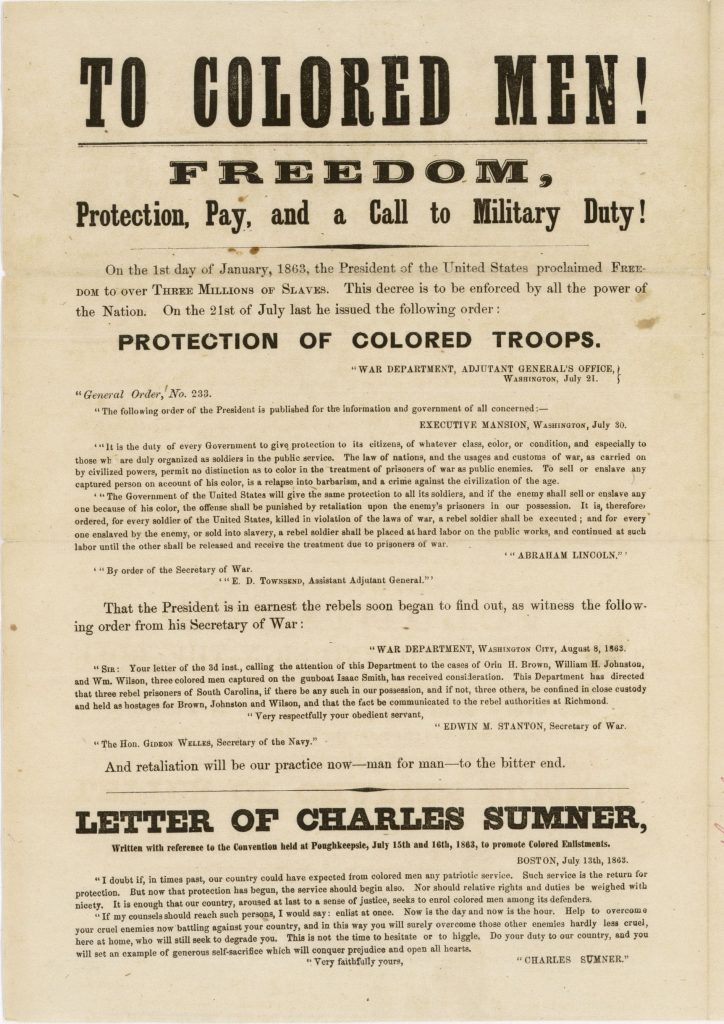
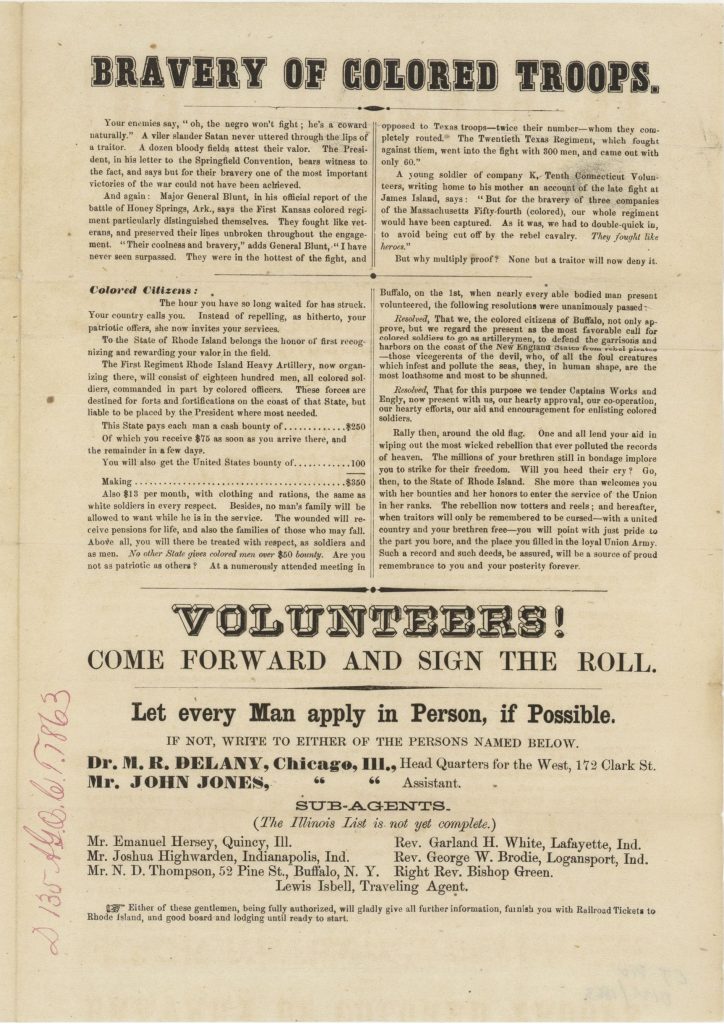
Documents
Document 5.1 – Samuel Cabble’s Letter Home
Document 5.2 – Sergeant William Carney, Medal of Honor Winner
Document 5.3 – Lewis Douglass’s Letter Home
Document 5.4 – Susie King Taylor
Document 5.5 – The Massachusetts 54th Regiment
Document 5.6 – Abraham Galloway
Check for Understanding
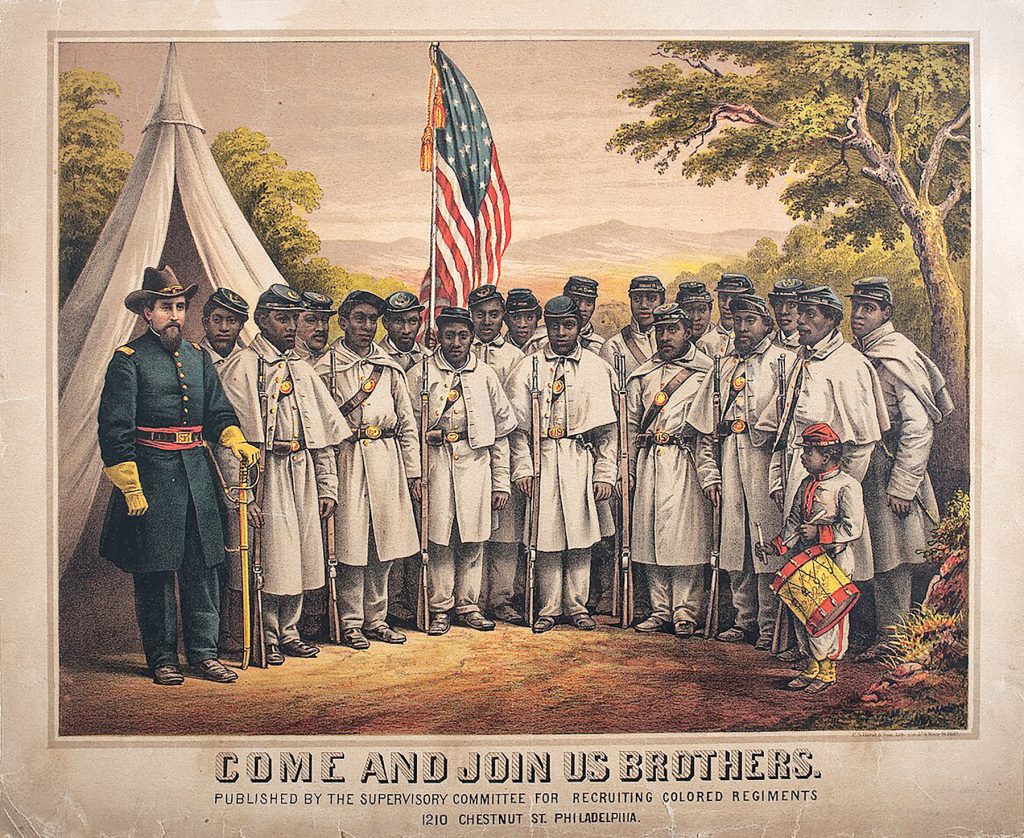
“Come and Join Us, Brothers” recruitment poster.
americanhistory.si.edu/collections/object/nmah_516030
Fredrick Douglass quote.
“You do not hesitate. You do not doubt. The day dawns; the morning star is bright upon the horizon! The iron gate of our prison stands half open. One gallant rush from the North will fling it wide open, while four million of our brothers and sisters shall march out into liberty.”
Additional Resources
Books
The Negro’s Civil War: How American Blacks Felt and Acted during the War for the Union
James M. McPherson, 2003
View on Amazon
The Black Civil War Soldier: A Visual History of Conflict and Citizenship
Deborah Willis, 2021
View on Amazon
Hope and Glory: Essays on the Legacy of the Fifty-Fourth Massachusetts Regiment
Martin H. Blatt, Thomas J. Brown, and Donald Yacovone, eds., 2001
View on Amazon
Websites
In Their Own Words: Diaries and Letters by African American Soldiers
National Museum of African American History & Culture
https://nmaahc.si.edu/explore/stories/their-own-words
This website is part of a collaborative initiative focused on digitizing and preserving oral histories of Black life in America. There are approximately 84 oral history tapes and reels, focused on Black residents of Washington, D.C. Students could be assigned to listen to one of the oral histories as another way to work toward a deep understanding of this topic.
African-American Soldiers during the Civil War
Library of Congress
https://www.loc.gov/classroom-materials/united-states-history-primary-source-timeline/civil-war-and-reconstruction-1861-1877/african-american-soldiers-during-the-civil-war/
The timeline traces three phases of the war: exclusion, mobilization, and impact. The first section features rejection letters to Black men seeking to join the Union army. After the Emancipation Proclamation, pay stubs and petitions reveal that Black soldiers were paid significantly less than white soldiers and document their fight for equal pay. The final section celebrates military achievements through officer reports and soldiers’ personal letters. It is a treasure trove of primary sources.
Sharing Unknown Stories of African American Civil War History
African American Civil War Memorial Museum
https://afroamcivilwar.org/
This site highlights the role of Black soldiers in the Civil War and provides educational resources for teachers, primary sources, and artifacts for exploring their wartime experiences.
Films
Glory
TriStar Pictures, 1989
This film tells the story of the Massachusetts’s 54th Regiment, focusing on Black soldiers’ determination to prove their worth in their fight for freedom. Critics of this film argue that it has too many elements of “white saviourism.” White saviourism, or white savior complex, is a critical term used to describe a phenomenon in which a white person or fictional character is portrayed as rescuing, assisting, or liberating people of color, often in a paternalistic or self-serving manner. Students could watch it for extra credit or extension work and assess the film for its alleged portrayal of “white saviourism.”
Fields of Glory
MTM Enterprises, 1993
This television film tells the story of the 33rd United States Colored Troops, depicting the immense difficulty and political resistance the men faced. It shows their fight for equal rank and pay, along with the challenges of fighting the Confederates. Students could watch this film and Glory and provide a film analysis of each film, delineating the pros and cons of each production.
Documentary
Bottom Rail on Top: The Civil War
PBS LearningMedia, 2023
https://rmpbs.pbslearningmedia.org/resource/6bd027aa-1bee-46c1-a42e-52ab009e3fa2/bottom-rail-on-top/
The ninth episode of Ken Burns’ documentary series The Civil War examines Black soldiers’ military contributions, the celebration of emancipation, and the opening months of Reconstruction. Clips from this documentary bring many of the people and events from this chapter to life.
Glossary
- 13th Amendment
- The 1865 constitutional amendment that abolished slavery throughout the United States.
- 14th Amendment
- The 1868 constitutional amendment that granted citizenship to all persons born in the United States and guaranteed equal protection under the law.
- 15th Amendment
- The 1870 constitutional amendment that prohibited denying the right to vote based on race, color, or previous condition of servitude.
- activism
- The practice of taking action to bring about political or social change.
- activist
- A person who campaigns to bring about political or social change.
- amendment
- A formal change or addition to the U.S. Constitution or other legal document.
- Emancipation Proclamation
- President Lincoln’s January 1, 1863 executive order declaring freedom for enslaved people in Confederate states.
- infantry
- Soldiers who fight on foot, as opposed to cavalry (mounted soldiers).
- lynching
- The illegal killing of a person, especially by hanging, by a mob as a form of racial terror and social control.
- mobilization
- The act of assembling and preparing military troops for active service.
- mutiny
- An organized rebellion against military or naval authority by soldiers or sailors.
- ratification
- The formal approval of a constitutional amendment, treaty, or agreement.
- secede
- To formally withdraw from membership in a political union or organization.
- valor
- Great courage shown in the face of danger, especially in battle.