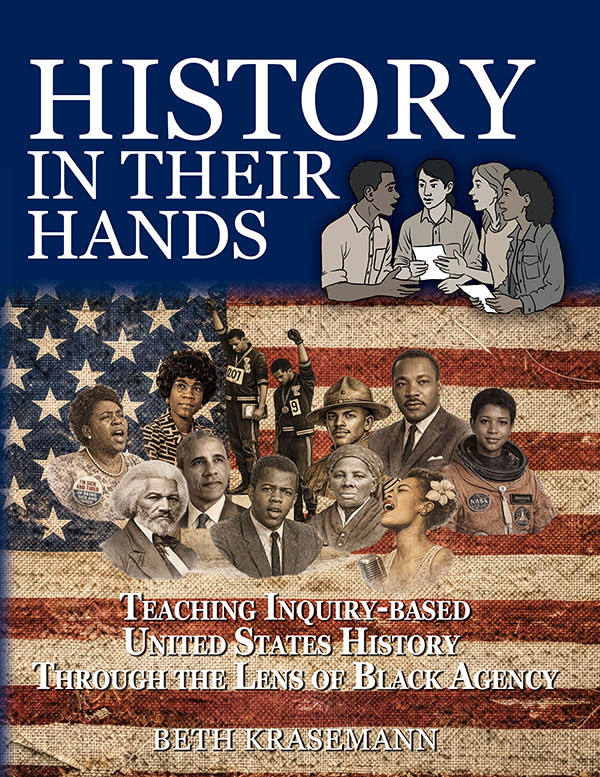
History in Their Hands
Teaching Inquiry-Based United States History Through the Lens of Black Agency
An inquiry-based approach to teaching U.S. history through primary sources and the history of Black agency.
History in Their Hands is a practical teacher guide to an inquiry-based US history curriculum that reimagines how we teach American history by centering the voices, actions, and resistance of Black Americans from 1619 to the present. Designed for middle and high school classrooms, the book offers lessons built around primary sources that invite students to investigate historical questions, analyze evidence, and develop their own interpretations of the past.
Each chapter explores a key moment or theme in the history of Black resistance and activism—from the Middle Passage and resistance to slavery through Reconstruction, the Jim Crow era, the Civil Rights Movement, and contemporary activism. By working directly with historical documents, images, and other sources, students examine how Black Americans challenged injustice and shaped the nation’s history.
The lessons are flexible and adaptable. Teachers can use individual inquiries as stand-alone activities, integrate them into existing units, or combine several chapters into a larger course exploring Black agency in United States history.
A companion website provides quick access to all primary sources used in the book, along with glossary lists and additional readings to support classroom use. Every document is ready to project to the classroom or shared with students — no prep required.
Key Features
- Inquiry-based lessons designed for middle and high school U.S. history classrooms
- Primary sources that encourage students to analyze evidence and develop their own interpretations
- Historical investigations spanning the Middle Passage, slavery, Reconstruction, Jim Crow, the Civil Rights Movement, and contemporary activism
- Guiding questions and teacher notes to support discussion and document analysis
- Flexible, adaptable lessons that can be used individually or combined into larger units or courses
- A companion website with primary sources, quick-projection mode, glossary lists, and additional teaching resources
Buy your copy today
About the author
Beth Krasemann is a passionate history educator who challenges her students to think, act, and write like true historians. She holds history degrees from Williams and Brown and has published the book Teaching the Holocaust By Inquiry. She taught at boarding schools on the East coast before returning to her roots in the mountains of the West, where she currently teaches at Colorado Rocky Mountain School in Carbondale, Colorado. She spends her free time running, biking, ski mountaineering, and reading. Summer vacations are full of travel, learning, and adventure.

Frequently Asked Questions
What grade levels is History in Their Hands designed for?
The book is designed for high school US history classrooms, including AP US History and AP African American Studies, but the inquiry-based lessons are adaptable and have been used successfully in advanced middle school settings as well.
Is this a student textbook or a teacher resource?
History in Their Hands is a teacher guide. It provides complete lesson frameworks — including primary sources, guiding questions, teacher notes, and discussion prompts — that teachers use to build and deliver inquiry-based lessons. Students work directly with the primary source documents, which are available on the companion website.
Can individual chapters be used on their own?
Yes. Each chapter is a self-contained inquiry unit that can be used as a stand-alone lesson, integrated into an existing unit, or combined with other chapters into a larger course. There is no requirement to teach the book from beginning to end.
How does this book differ from a standard US history textbook?
Rather than presenting a conventional narrative of American history, History in Their Hands centers Black voices, resistance, and agency at every stage of the story. Students are asked to investigate, analyze, and argue from evidence rather than absorb a pre-packaged account. The result is a history course that is both more accurate and more engaging.
What is on the companion website?
The companion website is an essential part of the book. Because primary sources, images, maps, and multimedia materials cannot always be reproduced in print in ways that are easy to share with students or projected to the classroom. The website provides electronic access to everything — including documents, photographs, video, audio, and important links, all organized by chapter. Rather than hunting down sources on your own, you’ll find everything curated and ready to use.
Do I need to teach the chapters in order?
No. While some chapters follow a chronological arc, others are organized thematically — exploring topics like Black soldiers across multiple wars, or the Civil Rights Movement outside the South. Teachers can select and sequence inquiries based on their curriculum needs, the time available, or the themes they want to emphasize.
History in Their Hands Details
History in Their Hands is available in paperback, hardcover, and e-book
- ISBN: 978-1-955604-26-0 (paperback)
- ISBN: 978-1-955604-27-7 (hardcover)
- 294 pages
- MSRP: paperback $34.95, hardcover $49.95, e-book $29.95
- Trim: 8.5×11″