Resources for Chapter 4 – Violent Resistance to Slavery
Opening Hook
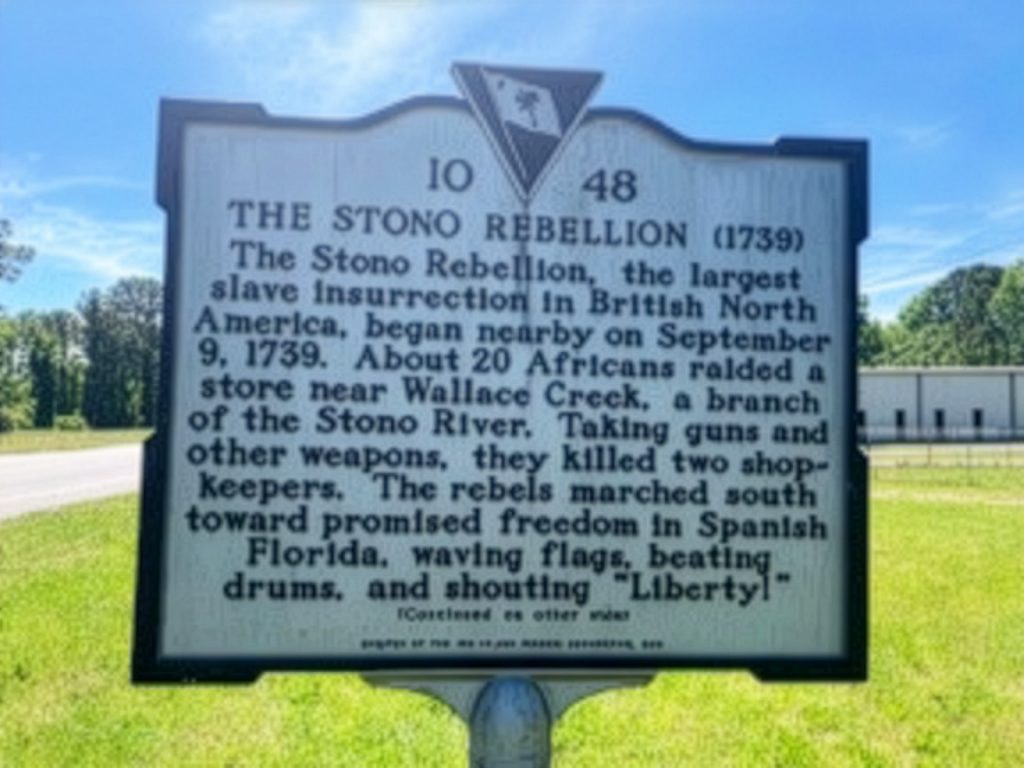
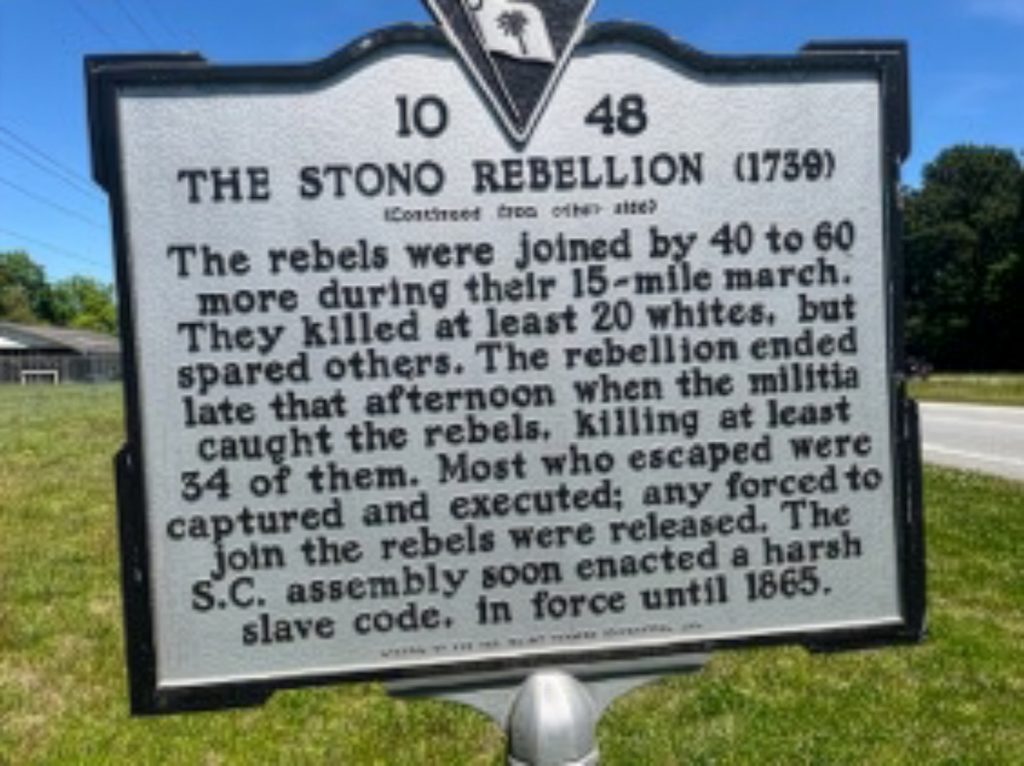
Images and text of the Stono Rebellion marker.
Bonus Content
The Stono Rebellion: Crash Course Black American History #6” (12 min).
https://www.youtube.com/watch?v=pND-9KhM1Xw
Documents
Document 4.1 – Slavery in the New York Colony
Document 4.2 – Toussaint L’Ouverture and the Haitian Revolution
Document 4.3 – Gabriel’s Rebellion (1800)
Document 4.4 – The 1811 German Coast Uprising, America’s Largest Slave Revolt
Document 4.5 – Denmark Vesey’s Revolt (1822)
Document 4.6 – The Nat Turner Rebellion (1831)
Check for Understanding
Verbal option
While the alleged and realized slave revolts were dramatic and inspiring, the costs were too high for the enslaved populations.
Written option
“I had reasoned this out in my mind, there was one of things I had a right to; liberty or death; if I could not have one, I would have the other.” — Harriet Tubman, 1886
Additional Resources
Books
American Negro Slave Revolts: 50th Anniversary Edition
Herbert Aptheker, 2013
View on Amazon
First published in 1943, this is a pioneering work that challenged the prevailing historical myth of the “happy” or “contented” enslaved person. Through exhaustive archival research, Aptheker meticulously documented over 250 instances of revolts and conspiracies by enslaved African Americans. The book’s core argument is that resistance and discontent were widespread and persistent throughout the 246 years of slavery, proving that the enslaved actively fought for their own freedom. Teachers could assign each student a revolt that is discussed in the book, to research and then share with the class.
These Truths: A History of the United States
Jill Lepore, 2018
View on Amazon
In Chapter 6 of this text Lepore discusses the fear of insurrection and the real event of Nat Turner’s Rebellion (1831) in Virginia, which profoundly impacted the South’s political and legal structure, leading to harsher slave codes. In “Part II: The People,” more cases of violent resistance are presented. Teachers could assign a reading to the entire class and debate: Were the costs of rebellions worth the gains?
A People’s History of the United States
Howard Zinn, 2015
View on Amazon
Zinn’s Chapter 9, “Slavery Without Submission, Emancipation Without Freedom,” details the frequent and determined resistance of enslaved people through methods ranging from slowdowns and sabotage to major revolts like those led by Nat Turner and Denmark Vesey. The chapter can be shared with students, with an eye towards understanding the common interests of poor Black and white people.
The Land Shall Be Deluged in Blood: A New History of the Nat Turner Revolt
Patrick Breen, 2015
View on Amazon
This text investigates the divisions and ambiguities even among the enslaved communities about how to resist slavery. Breen argues that elite slaveholders deliberately used the post-revolt trials and judicial process to further terrorize the enslaved population to protect their property. This text is an exemplary narrative grounded in rigorous research to debunk many myths and distortions about Nat Turner.
Websites
Africans in America
https://www.pbs.org/wgbh/aia/home.html
The Africans in America website is a companion to Africans in America: America’s Journey through Slavery, a four-part documentary series. The series, which can be found online, explores how a nation founded on liberty simultaneously built its economy and society upon the enslavement of Black people. The website contains teacher guides, narrative, and some interactive elements.
Libguides: African-American Rights Movements: Slave Rebellions, Montana State University
https://libguides.msubillings.edu/c.php?g=902153&p=6492366
This site offers many primary sources and multimedia resources to further study the many forms of violent resistance against slavery. It examines major conspiracies and revolts, such as those led by Gabriel Prosser, Denmark Vesey, and Nat Turner, which, though violently suppressed, terrified slaveholders and led to increasingly harsh laws.
Films and Documentaries
Harriet
Focus Features, 2019
This biographical film about Harriet Tubman is set in the US and focuses on her work as a conductor on the Underground Railroad. While not a large-scale slave revolt, it depicts Harriet’s highly dangerous and armed efforts to liberate enslaved people and features several scenes of violent confrontations with slave catchers, emphasizing the necessity of armed defense for freedom. This complicates the traditional narrative that the Underground Railroad was a nonviolent avenue of resistance. Violent resistance was an integral part of the planned escapes.
Nat Turner: A Troublesome Property
PBS, 2002
https://www.kanopy.com/en/category/758
This is an older docudrama that aired on PBS’s Independent Lens. It explores not only the events of the 1831 revolt but also the various, often conflicting, ways Nat Turner has been remembered, portrayed, and reinterpreted throughout American history. It blends historical reenactments with scholarly commentary. If shared with the class, teachers can challenge students to point out conflicting narratives presented about Turner.
Resistance to Slavery
Robert H. Smith Center for the Constitution at James Madison’s Montpelier, 2016
https://www.youtube.com/watch?v=_xF-fBT0MI8&t=1s
This documentary focuses on how enslaved people actively asserted their humanity and agency despite the system designed to dehumanize them. This resistance was expressed not only through major acts, like rebellion, but also daily acts of survival, such as building families, organizing their own religious practices, and striving to control as much of their personal lives as possible. To increase student engagement, teachers can ask students to note any act of resistance throughout the documentary; a long list would be generated, demonstrating a wide range of avenues of resistance.
Glossary
- analyze
- To examine something in detail to understand it better.
- auction
- A public sale where enslaved people were sold to the highest bidder.
- campaign
- An organized course of action to achieve a goal, particularly in military or political contexts.
- Confederacy
- The Southern states that seceded from the United States and formed their own government during the Civil War.
- Confederate
- Relating to the Confederate States of America or its military forces.
- conspiracy
- A secret plan by two or more people to commit an unlawful or harmful act.
- Constitution
- The fundamental principles and laws of a nation that determine the powers and duties of the government and guarantee certain rights to the people.
- context
- The circumstances or setting in which something occurs.
- discrimination
- The unjust or prejudicial treatment of different categories of people, especially on the grounds of race.
- enlistment
- The act of voluntarily joining the military for service.
- enslaved
- The state of being held in slavery; owned by another person and forced to work without pay.
- evaluate
- To assess the value, quality, or importance of something.
- execution
- The carrying out of a death sentence.
- interpret
- To explain or understand the meaning of something.
- militia
- A military force of citizens rather than professional soldiers.
- plot
- A secret plan or scheme to carry out an illegal act.
- proclamation
- An official public announcement or declaration.
- racial
- Relating to race or the relations between different races of people.
- regiment
- A permanent military unit commanded by a colonel.
- segregation
- The enforced separation of racial groups in daily life, including schools, transportation, and public facilities.
- slave trade
- The business or process of transporting and selling enslaved people.
- torture
- The act of causing severe pain or suffering as punishment or to force compliance.